
What is variable resistance training? A practical band guide
Variable resistance means the external resistance changes during a movement. With an elastic band, tension generally rises as it stretches. That does not mean every exercise gets hardest at the end: leverage and the direction of pull matter too.
By Band team
Published 3 min read
Updated
Practical guidance from the Band team.
Stretch changes tension
Measurements of elastic bands show that tension varies with elongation. The study linked below measured particular products under defined conditions; its results are not a universal calibration for every band.
The practical takeaway is to keep your setup repeatable. A different grip length or starting position can change the resistance even when you use the same band.
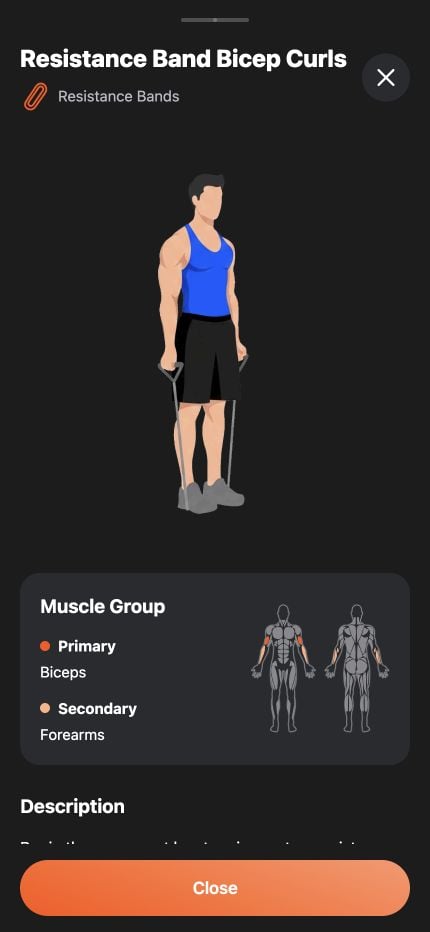
Picture a band curl
At the start, the band may have relatively little stretch. Raising the handles lengthens it and increases its pull. Your forearm angle also changes, affecting the demand around the elbow.
This is a qualitative explanation, not a measured force curve for the band in the screenshot. The app does not measure band tension.
Three terms that are easy to confuse
Use these distinctions when reading labels or comparing equipment.
| Term | Meaning | Practical implication |
|---|---|---|
| Band tension | The pulling force produced by the stretched band | Depends on the band and its elongation |
| Muscular demand | The demand on muscles during the movement | Also changes with leverage and body position |
| Progressive overload | Increasing training demands over time | Different from tension changing within a single repetition |
Make sessions easier to compare
Choose an exercise and keep its setup consistent before judging changes in performance.
- Use the same band and identify it clearly.
- Repeat the grip, starting position, and anchor height when applicable.
- Keep movement range and control consistent.
- Review repetitions or time alongside setup, rather than relying on color alone.
What the resistance curve cannot promise
An increasing tension curve is not automatically a perfect match for a person’s strength curve. It does not prove that bands are universally safer, easier on joints, or better for muscle growth.
Follow the manufacturer’s stretch limits instead of testing how far the band can go. Never infer a safe maximum from a graph measured on another product.
Read what muscle-building research can tell usKeep a setup note, not just a band color
A useful comparison needs more than “blue band.” Record the setup in your own notes so you can recognize what changed. This example is a paper or notes-app checklist, not a feature claim about Band.
| Record | Example entry |
|---|---|
| Exercise | Band bicep curl |
| Equipment | My handled tube band; identify the specific product |
| Placement | Under the feet, following the demonstration |
| Grip and starting position | Same handles, stance, and starting arm position |
| What happened | Repetitions completed and whether the movement stayed controlled |
| What changed next time | Record any different band, grip, stance, or range |
If you shorten the working length and complete fewer repetitions, the sessions used different setups. Record that difference rather than assuming you lost strength. The checklist improves comparison; it does not measure force or calculate an equivalent weight.
Apply the idea in Band
Preview the demonstration and instructions, then use a familiar setup for your selected movements. Builder helps organize exercise order, timing, rest, and rounds. Adjust the routine deliberately rather than treating a longer stretch as a free upgrade.
Organize your next workoutResearch sources
Before you train
Choose an amount of exercise that suits your current ability. Stop for pain, dizziness, or unusual breathlessness. If an injury or health condition affects exercise, seek advice from a qualified health professional.
Your next session starts here.
Take what you learn into BAND with guided workouts, interval timers, and voice cues.
Keep learning
Equipment comparisons3 min read
Resistance bands vs. dumbbells: choose for your routine
Compare resistance bands and dumbbells for home workouts, progression, portability, and exercise setup, with practical examples from Band.
Equipment comparisons3 min read
Resistance bands vs. the gym: where will you train?
Compare home resistance band training with a gym membership for equipment, time, cost, coaching, and consistency.
Equipment comparisons3 min read
Resistance bands vs. cable machines: what changes?
Compare band and cable resistance, anchors, load selection, and movement setup before choosing exercises for home or the gym.
Training evidence3 min read
Do resistance bands build muscle? What the evidence says
Understand the evidence for resistance bands, the difference between strength and muscle growth, and practical ways to structure training.