
Resistance bands vs. cable machines: what changes?
Bands and cables can both pull from an anchor direction, but their resistance behaves differently. A band’s tension changes as it stretches. A cable machine uses a mechanism such as a weight stack, with handle resistance affected by its pulley arrangement and design.
By Band team
Published 3 min read
Updated
Practical guidance from the Band team.
Similar movement directions, different equipment
This comparison refers mainly to weight-stack cable machines. Other cable systems can use different mechanisms.
| Consideration | Resistance bands | Weight-stack cable machine |
|---|---|---|
| Load selection | Choose a band and repeat the same starting setup | Select the stack setting; follow that machine’s instructions |
| Resistance through movement | Changes with band stretch | Depends on stack, pulley ratio, friction, and machine design |
| Anchor direction | Depends on a suitable compatible attachment | Often adjustable using built-in pulley positions |
| Space | Portable, but still needs clearance and a suitable setup | Requires a fixed machine and space around it |
| Progress comparisons | Keep band, grip, starting length, and position consistent | Keep machine, attachment, setting, and position consistent |
The numbers are not interchangeable
A stack label and a band’s printed resistance do not establish the same load at your hands. Cable routing can change the relationship between stack mass and handle force; band ratings depend on how the product is measured and stretched. The Life Fitness specifications linked below illustrate why stack weight and effective resistance may differ.
Neither tool gives constant muscular demand throughout every movement. Body position and the moment arm around a joint matter as well.
Understand variable resistanceMatch the actual exercise setup
A cable row and a band row may share a pulling pattern, but changing the anchor height or body position changes the exercise. Do not replace a cable movement merely by attaching a band somewhere nearby.
Our bent-over row demonstration uses its own pictured setup. Read those instructions rather than treating it as a direct copy of a seated cable row.
Review the Band bent-over row setupWhen each option may fit
Bands can fit a portable home routine when suitable exercises and attachments are available. A cable machine may be convenient when you want built-in anchor adjustments and repeatable machine settings.
Use manufacturer-approved attachments and follow installation and operating instructions. A band anchor is part of the load-bearing setup, not an optional detail.
Before replacing a cable row with a band row
Compare the direction of pull, your body position, and the point supporting the load. A seated cable row pulls from a machine in front of you. The Band bent-over row shown on this site places the band under your feet and changes your torso position.
Those are different setups even though both use a rowing motion. Start by reading the full band instructions; do not copy the cable setting, repetitions, or body position automatically.
- Find an actual demonstration for the band variation you intend to use.
- Check whether its anchor is under-foot or external.
- Confirm that you can maintain the required position in your space.
- Use a different suitable movement if your equipment cannot reproduce the demonstrated setup.
Preview before building your routine
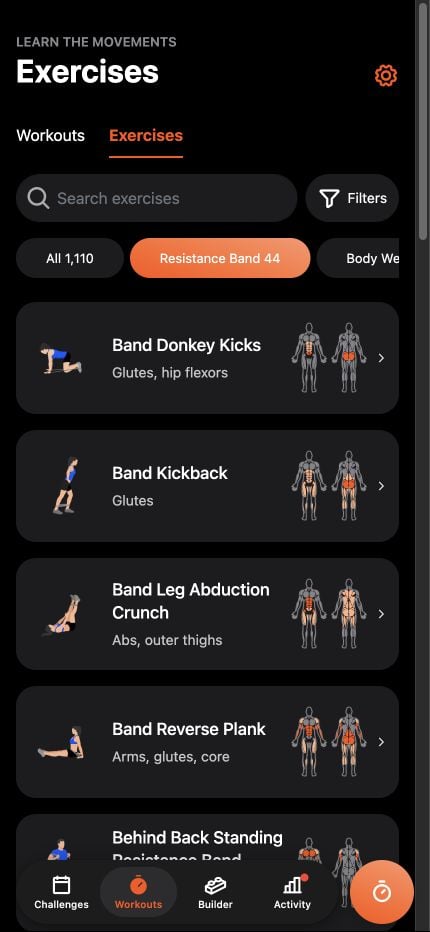
Band’s exercise library shows movements, instructions, and muscle information. Pick exercises that match your available equipment, then arrange them in Builder. The app does not calculate an equivalent cable-stack setting.
Research sources
Before you train
Choose an amount of exercise that suits your current ability. Stop for pain, dizziness, or unusual breathlessness. If an injury or health condition affects exercise, seek advice from a qualified health professional.
Your next session starts here.
Take what you learn into BAND with guided workouts, interval timers, and voice cues.
Keep learning
Equipment comparisons3 min read
Resistance bands vs. dumbbells: choose for your routine
Compare resistance bands and dumbbells for home workouts, progression, portability, and exercise setup, with practical examples from Band.
Equipment comparisons3 min read
Resistance bands vs. the gym: where will you train?
Compare home resistance band training with a gym membership for equipment, time, cost, coaching, and consistency.
Training principles3 min read
What is variable resistance training? A practical band guide
Learn how band stretch changes resistance, why setup matters, and how to compare sessions without treating band labels as exact weights.
Training evidence3 min read
Do resistance bands build muscle? What the evidence says
Understand the evidence for resistance bands, the difference between strength and muscle growth, and practical ways to structure training.